The business is working. But is it working for you?
-- Please Note - A version of this article first appeared on Extra Brain – Founder’s Block on Substack. It is republished here in an expanded form. --
Your energy as a founder is not a luxury you earn once the to-do list is finished. It is the fuel. And most founders are running on empty without realising it.
I know a founder who is seriously passionate about video. They have a genuine hunger for new tools, new techniques, and new ways of working. They want to learn and experiment with it all. But every week goes by and there's no time. They are too busy running the business to do the work they started it for.
I hear a similar version of this in a number of conversations I have with founders.
Most of them didn't start their business to manage people, chase invoices, or sit on endless Zoom calls. They started because they were brilliant at something, like design, video, writing, or coding, and they wanted the space to do it their way. So, they took the leap.
And it worked. But success brings new, unexpected things to focus on. You win new clients, projects land, and you hire your first employee. Slowly, without you ever consciously deciding it, the week fills up. You're managing problems, managing people, and keeping everyone else happy. The craft and the passion are still on the list, but they are always at the bottom.
A business designed for someone you used to be
Here is what I think is actually happening underneath all of this.
When you start a business, you design it around who you are at that point. Your skills, your energy, your tolerance for the messy bits. In the early days that works, because you are close to everything.
But the business changes shape. It needs things from you that it didn't need before. And because there is nobody else to do it, you absorb all of that. Bit by bit, year by year.
Meanwhile, you've changed too. You've grown. Your interests have shifted. The things that used to feel fine now feel heavy. But the role you play inside the business hasn't caught up with any of that. It was designed for an earlier version of you, and an earlier version of the business. Both have evolved. Your role just accumulated.
"You're almost a victim of your own success. You started with something you were passionate about. Then slowly you're doing all the crap that feeds the engine. The stuff you love doing gets dropped to the bottom of the priority list."
When I ran my agency, I loved the challenge of learning new things, solving problems, and expanding my skills. But over time, it took its toll. I neglected my creative side and stopped learning my craft. Eventually, I burned out and was forced to stop.
Looking back, I experienced every challenge from cash flow to contract disputes. While I enjoyed finding solutions, much of it had nothing to do with my "why." Give me a finance spreadsheet and watch the joy drain from my face.
A simple way to see it
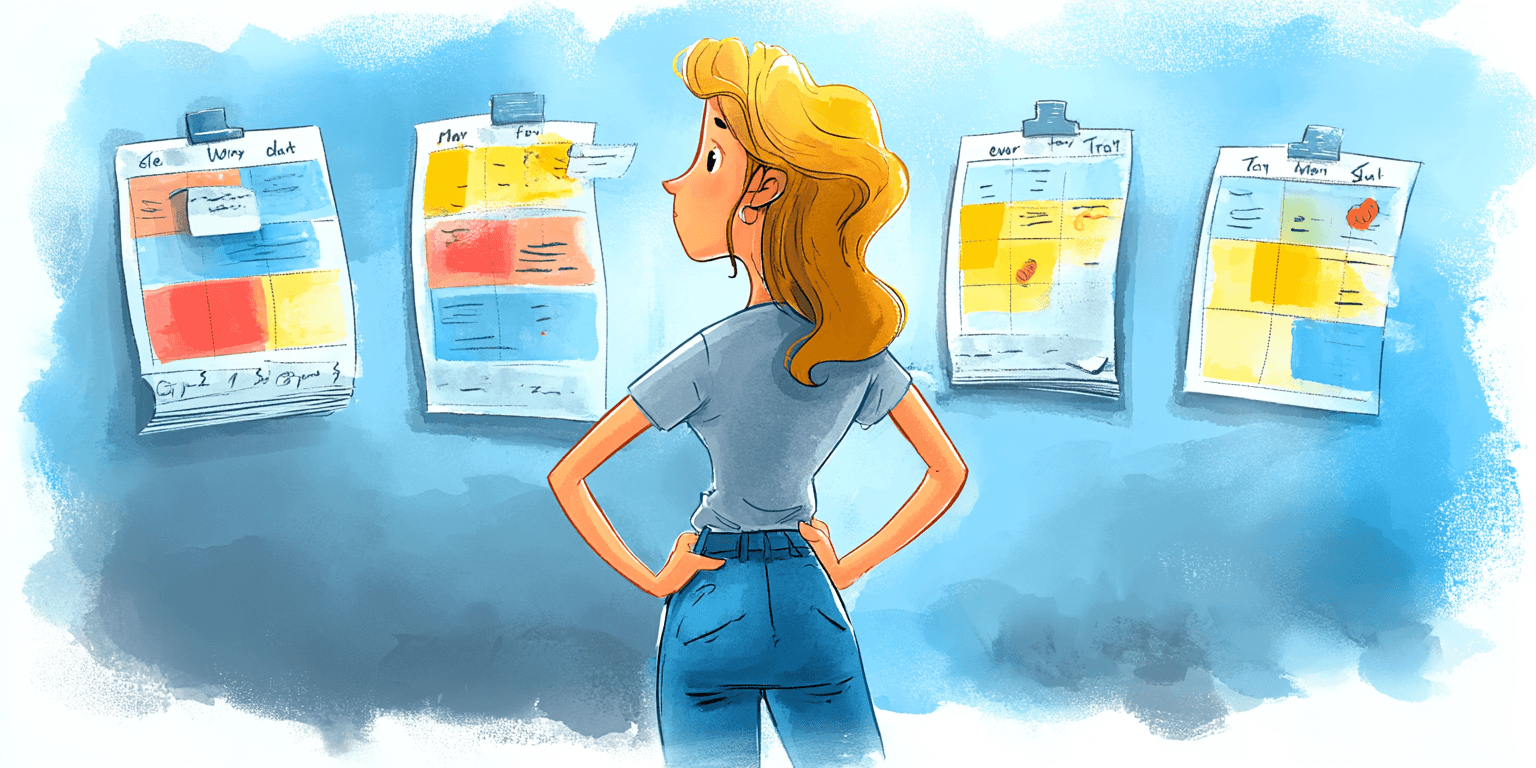
So, when I work with founders and sense something important is being quietly starved, I ask them to do a simple energy audit. Try it yourself. Pull up your calendar for the last month and colour-code it.
Green for the work that genuinely gives you energy and joy.
Amber for the stuff you don't mind, but don't love.
Red for the tasks that drain you.
One founder did this with me recently. When we looked at it together, there was almost no green. Their business was doing brilliantly, but they'd built a working week that was slowly draining them. They hadn't let themselves see it until we laid it out on the screen.
What to do with what you find
The audit on its own just shows you the problem. The natural question is "so then what?" Here is how I think about it.
The three questions
The red tasks: can this leave your plate entirely?Delegate it, automate it, or stop doing it. If it is draining you and someone else could do it, even imperfectly, it should not be yours. The standard does not have to be your standard. It just has to be good enough.
The amber tasks: can this take less of you?Batch it into a single morning. Create a template so it takes ten minutes instead of forty. Reduce how often it happens. Amber tasks are not the enemy, but they should not be eating your best hours.
The green tasks: can you protect and expand these?This is the work that keeps you in the game. Not just productive, but actually engaged. If you are only doing two hours of green work a week, something needs to change.
If you want to take it further, try plotting your tasks on two axes: how much time something takes, and how much energy it gives or costs you. Four areas emerge naturally.
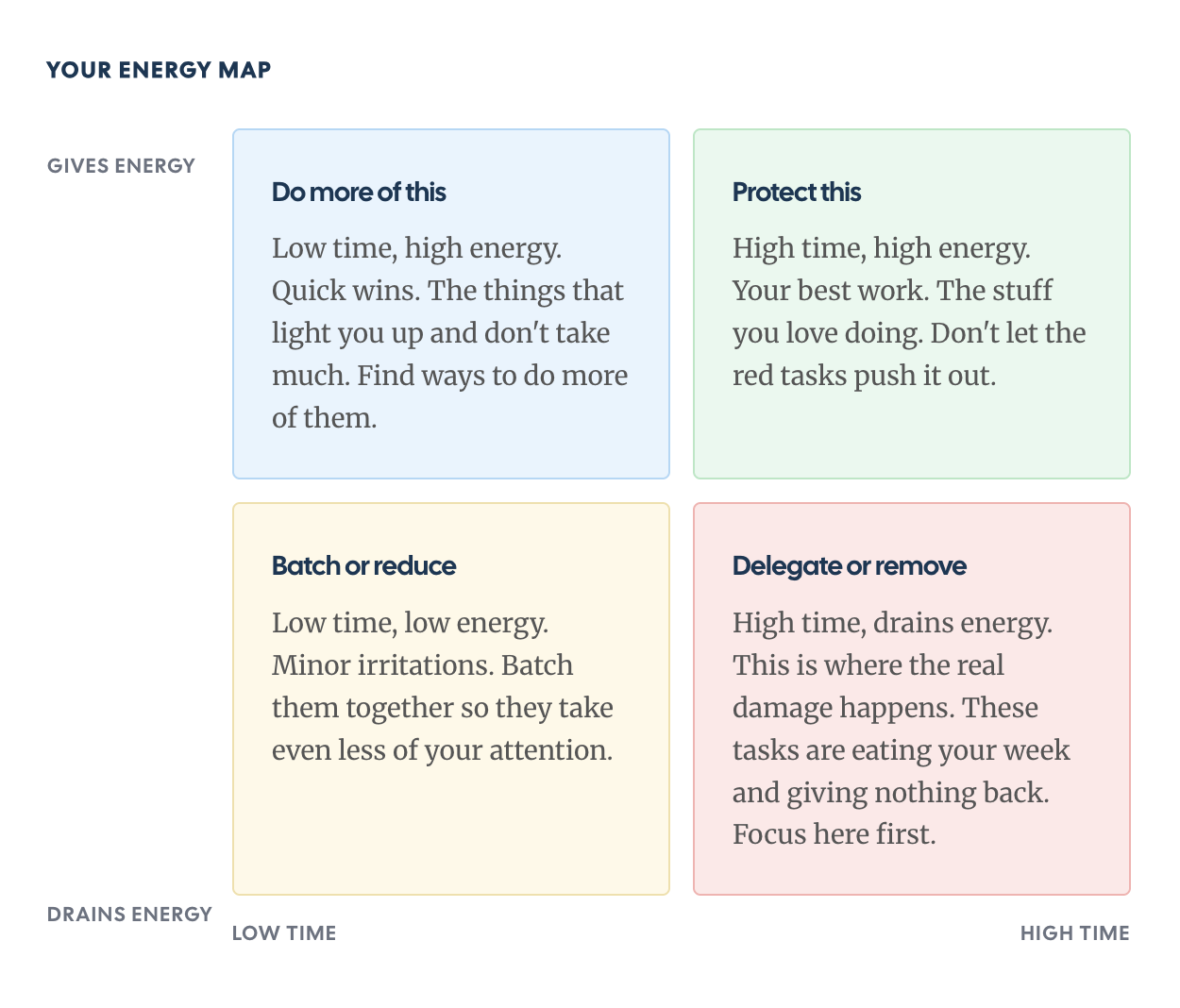
The bottom right quadrant is usually the revelation. High time, drains energy. That is where most founders are spending far more of their week than they realise. And it is almost always stuff that someone else could be doing.
Don't think of your curiosity like a dividend
Running a business is genuinely hard. It can be lonely and relentless, and it asks a lot of you without always giving much back. If you've lost that spark, it doesn't mean you've failed or made the wrong choices. It usually just means you've been carrying a lot for a long time, and the business hasn't kept up with who you've become.
Don't think of your passion and your curiosity like a dividend. They shouldn't be something you only take once there's a profit and everyone else is happy.
Your energy is not a luxury you earn once the to-do list is finished.
Energy and passion are the fuel that keeps you going. When that fuel disappears, the business might still run, but you'll start every week with a little less in the tank. Eventually, you're just grinding.
Create the space. Then protect it.
Take a look at your calendar for the next couple of weeks. Create a couple of slots to explore things that excite you, spark your passion, and drive your interest. Commit to them, and then protect them as much as you would a client meeting.
The space doesn't usually appear on its own. You have to create it. If the things that energise you are always waiting for a "quieter week," they'll keep waiting forever.
The founder I mentioned who is passionate about video is a great example. In our last meeting, they'd booked days out to explore their passion, and we worked on making sure the business carried on around them while they did.
Seeing their face when they talk about that work now is exactly why I do this. I want to help founders build businesses they actually enjoy running over the long term.
Because what's the point otherwise?